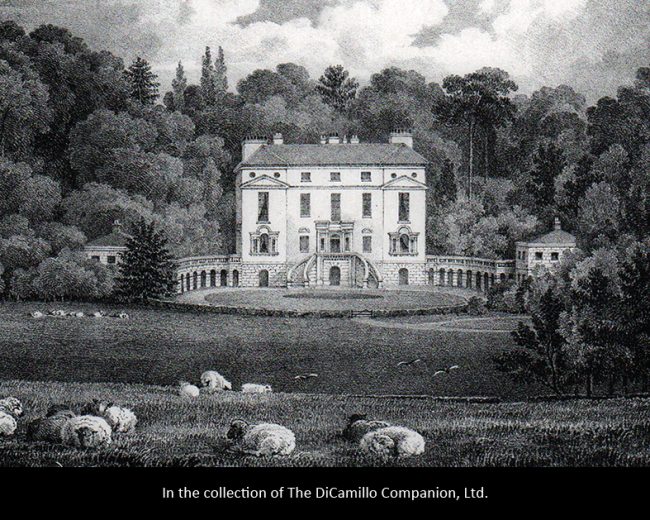
An 1828 engraving of the house from "Prosser's Select Illustrations of the County of Surrey"
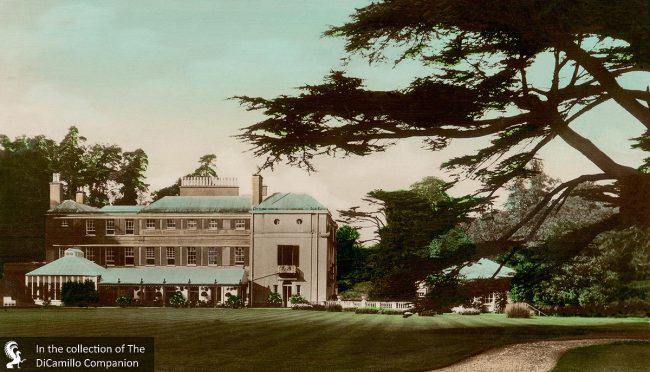
The garden facade from a circa 1915 postcard
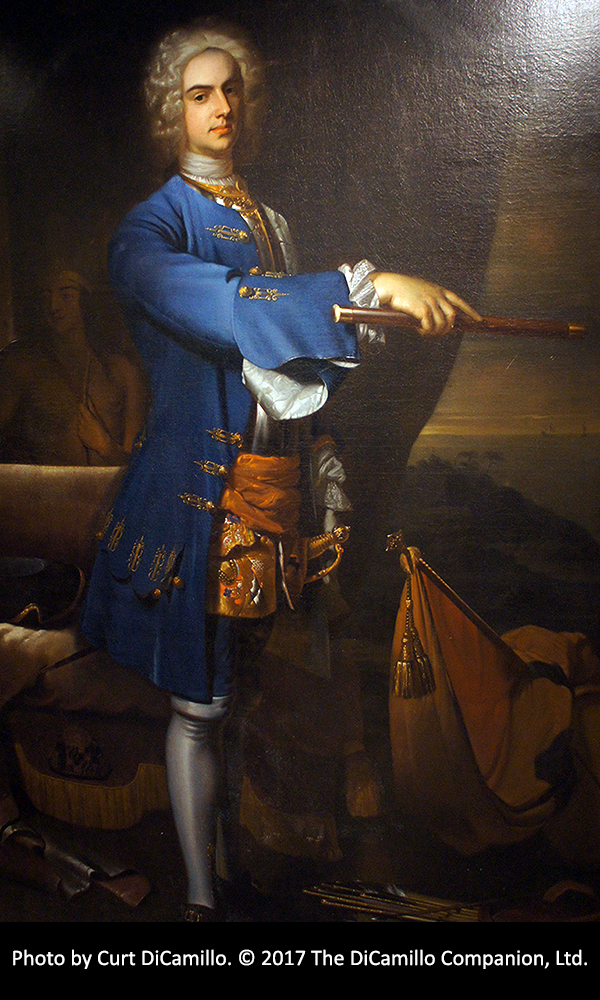
Portrait of the 5th Lord Baltimore by Herman van der Mijn, circa 1732, today in the collection the the Maryland Historical Society.
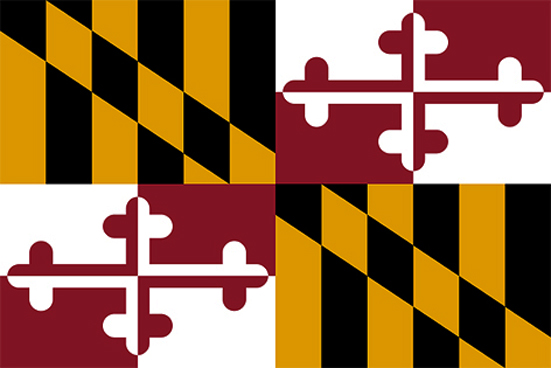
The Maryland state flag, which features elements of the arms of Lord Baltimore. This image is in the public domain.
Earlier Houses: What is today the Woodcote Park Estate was mentioned as early as 727 as being a part of the land near Epsom granted to Chertsey Abbey. In 1537, as part of the Dissolution of the Monasteries, Henry VIII seized or "purchased" the abbey's lands, which he granted to Sir Nicholas Carew. Sir Nicholas only owned the property for two years: in 1539 he was attained and executed for his alleged part in the Exeter Conspiracy. At Sir Nicholas's attainder, the estate was returned to the crown. By the mid-16th century the Woodcote Estate was in the ownership of John Ewell of Horton, who may have built a manor house in the grounds. In 1648 Richard Evelyn, brother of the famous diarist John Evelyn, inherited the estate through his wife and began construction of a new house (mentioned in the diaries of Samuel Pepys).
House & Family History: At her death in 1692 Elizabeth Evelyn (widow of Richard Evelyn) bequeathed Woodcote to Charles Calvert, 3rd Baron Baltimore, “a connexion of her family.” It is this family that is most associated with Woodcote Park today. George Calvert, 1st Baron Baltimore (1579–1632), applied to Charles I for a grant of land than spanned from Massachusetts in the north to Virginia in the south. On June 20, 1632, months after the 1st Lord Baltimore’s death, the charter for a much smaller parcel of land was granted to his son, Cecilius Calvert, 2nd Baron Baltimore, who became the first proprietor of the colony of Maryland. Named in honor of Henrietta Maria, the Catholic (and French) queen of England, Maryland was founded as a haven for English Catholics, who were facing rising religious persecution in their native land. Lord Baltimore, who was himself Catholic, wanted to create a place of religious tolerance in the New World where Catholics could live in peace. Maryland was owned by the Calvert family until the proclamation of American independence in 1776 (the Barony of Baltimore became extinct in 1771, upon the death of the 6th Lord Baltimore). In addition to founding the colony, the 2nd Lord Baltimore was also responsible for the Maryland state flag and the state bird. The flag, which this author considers the most beautiful state flag in America, is formed from elements of Lord Baltimore’s coat of arms. The Baltimore Oriole, a small blackbird, became the Maryland state bird because of the resemblance of the male’s colors to those in Lord Baltimore’s arms. Woodcote Park remained in the ownership of the Calvert family until it was sold in 1770 by the 6th Lord Baltimore, who was experiencing financial difficulties. Woodcote remained a private home until Herbert Brooks, a director of the Bank of England, sold the house and estate in 1913 to the Royal Automobile Club (RAC), who redeveloped it as a country club. Most of the interiors commissioned by the Calverts, some of which were considered among the finest Rococo interiors in England, were destroyed by the RAC when they converted the house into a clubhouse. In 1913 the RAC instructed the London dealer Harold Lancaster to remove and sell a number of the historic paneled rooms, some of them noted for their murals by important Italian artists such as Antonio Verrio. In 1927 one of those paneled rooms, a drawing room called the Morning Room, was sold by the London dealer Robersons to Eben Howard Gray, a Boston banker, who donated it to the Museum of Fine Arts, Boston (MFA), the same year. Mr. Gray filled the room, noted for its French Rococo style boiseries and its Rococo marble fireplace designed by Sir Henry Cheere, with his important collection of Chippendale furniture. Unveiled and opened to the public as the Chippendale Room, it was quickly determined that most of the pieces of Chippendale furniture that Mr. Gray donated to the MFA to furnish the room were forgeries. Continuing the trend of unpleasant discoveries, in the early 21st century it was discovered by the late architectural historian John Harris that a number of the boiseries in the Morning Room had been manipulated (mixing genuine paneling with early 20th century reproductions). Though the MFA still owns the room today, it is in storage and not on view to the public. (The MFA’s boiseries are based on illustrations in the 1738 French publication De la Distribution des Maisons de Plaisance by J. F. Blondel.) In 1934 Woodcote Park burned to the ground. Over the next two years the house was rebuilt as a virtual replica of its original design by Mewès & Davis, the firm who had also designed the Royal Automobile Club’s grand clubhouse in Pall Mall between 1908 and 1911. (Mewès & Davis is most famous today for designing the London Ritz hotel, which opened in 1906.)
Garden & Outbuildings: The house is today set in 350 acres of parkland that includes two 18-hole golf courses and tennis and squash courts. The gardens remain in their original layout with many cedars of Lebanon that were planted circa 1800. During World War I soldiers were trained at Woodcote; during the Second World War the grounds were turned over to food production.
Architect: Francis Brerewood
Date: 1753-58Architect: John Vardy Sr.
Date: Circa 1755John Bernard (J.B.) Burke, published under the title of A Visitation of the Seats and Arms of the Noblemen and Gentlemen of Great Britain and Ireland, among other titles: Vol. I, p. 231, 1852.
Title: Moving Rooms: The Trade in Architectural Salvages
Author: Harris, John
Year Published: 2007
Reference: pgs. 155, 157, 158
Publisher: New Haven: Yale University Press
ISBN: 9780300124200
Book Type: Hardback
Title: Biographical Dictionary of British Architects, 1600-1840, A - HARDBACK
Author: Colvin, Howard
Year Published: 2008
Reference: pgs. 154, 1075
Publisher: New Haven: Yale University Press
ISBN: 9780300125085
Book Type: Hardback
House Listed: Grade II*
Park Listed: Not Listed
Past Seat / Home of: SEATED AT EARLIER HOUSES: Sir Nicholas Carew, 1537-39. John Ewell, early 16th century; Ewell family here until 1591. John Mynn(e), late 16th century; Sir William Mynne, early 17th century; George Mynne, until 1648. Richard Evelyn, 1648-49. SEATED AT CURRENT HOUSE: Richard Evelyn, 1649-70; Evelyn family here until 1692. Charles Calvert, 3rd Baron Baltimore, 1691-1715; Benedict Leonard Calvert, 4th Baron Baltimore, 1715; Charles Calvert, 5th Baron Baltimore, 1715-51; Frederick Calvert, 6th Baron Baltimore, 1751-70. Thomas Monk; 1770-77. George Nelson, 1777-88. Arthur Cuthbert, 1788. Lewis de Teissier, 1st Baron de Tessier, 19th century; James de Teissier, 2nd Baron de Tessier, until 1856. Robert Brooks, 1856-82; Herbert Brooks, 1882-1913.
Current Ownership Type: Club
Primary Current Ownership Use: Club
Ownership Details: Since 1913 the country club of the Royal Automobile Club
House Open to Public: No
Phone: 01372-276-311
Fax: 01372-276-117
Email: [email protected]
Website: https://www.royalautomobileclub.co.uk
Historic Houses Member: No