

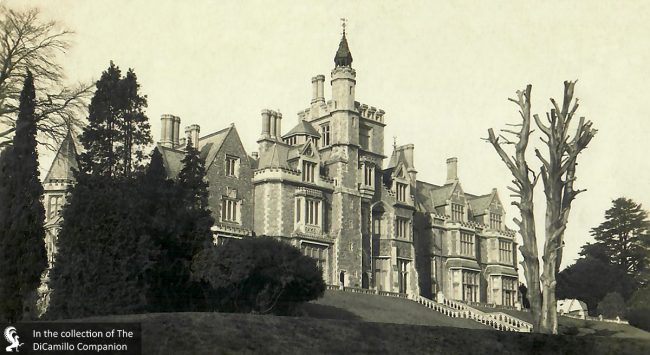
The house from a circa 1909 postcard
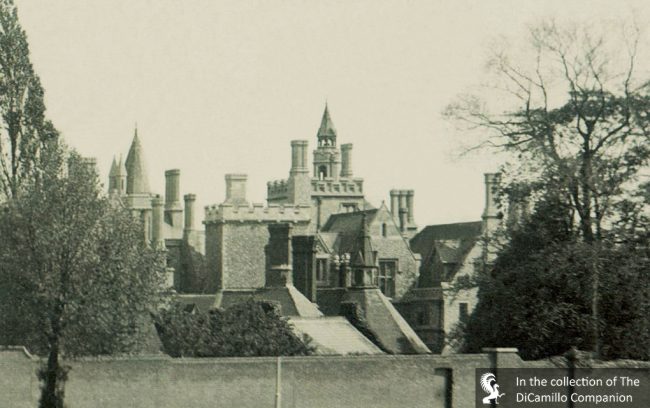
The house from a 1908 postcard
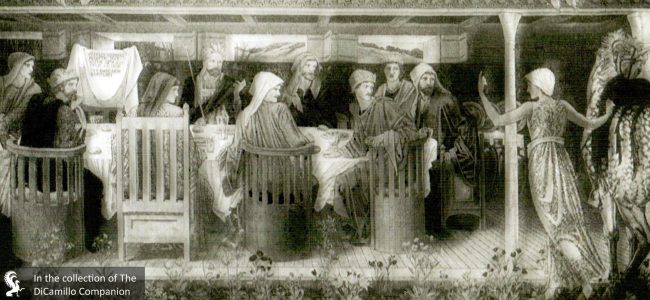
A circa 1900 magic lantern glass slide of one of the Morris & Co. tapestries in the "The Failure of Sir Gawain and Sir Ewain to Achieve the Holy Grail" series woven for William Knox D'Arcy for Stanmore Hall.
Earlier Houses: There was at least one earlier house on, or near, the site of the current house.
House & Family History: In the late 19th and early 20th centuries Stanmore Hall was the home of the British-Australian millionaire William Knox D'Arcy. Born in Devon, D'Arcy moved with his family to Australia in 1866, where he remained until 1889, when he returned to Britain and purchased the Stanmore Estate. D'Arcy is notable because of his involvement in the formation of what eventually became BT (British Petroleum). In 1901 the D'Arcy Concession, which gave D'Arcy the rights to search for oil in an area of Iran (Persia) that covered 480,000 square miles, was signed (the Iranian government was given 16% of the oil company's annual profits in return for the concession). This astonishing agreement, which gave D'Arcy the oil rights to the entire country, except for five provinces in Northern Iran, made him a very rich man. In 1909 D'Arcy founded the Anglo-Persian Oil Company, which later became BP. The D'Arcy Concession remained in effect until 1952, when the Iranian government nationalized the oil industry. During World War II the house was used as accommodation for officers of the Allied Expeditionary Air Force who were training for Operation Overlord. In the 1970s Stanmore was owned by the local health authority and used by the Royal National Orthopaedic Hospital as a home for nurses. During the 1980s the house was converted into offices that housed a computer software company and, lastly, the UK headquarters of the Swedish automobile manufacturer Volvo. In the 1990s Stanmore Hall was converted into condominiums.
Collections: Stanmore Hall is famous for its 1890s Morris & Co. interiors. A Morris & Co. tapestry, "The Failure of Sir Gawain and Sir Ewain to Achieve the Holy Grail," designed by Edward Burne-Jones and woven by Morris & Co. for Stanmore in 1894 as part of a set of six (this was the first in the series), was sold at Christie's on June 9, 2004, for £386,050. The set, commissioned by William Knox D'Arcy for the dining room at Stanmore, was called by Nicola Redway "one of the finest artistic achievements of the Arts and Crafts movement." There were also paintings by Frederick Goodall and Frank Dicksee that hung in the hosue. Much of the contents were sold in 1920.
Garden & Outbuildings: The house today sits in just under three acres of grounds.
Architect: Brightwen Binyon
Date: 1888–91
Title: Buildings of England: Middlesex, The
Author: Pevsner, Nikolaus
Year Published: 1951
Reference: pg. 146
Publisher: London: Penguin Books
ISBN: NA
Book Type: Hardback
Title: Country Life (magazine)
Author: NA
Year Published: NA
Reference: May 6, 1999
Publisher: Bath: Future plc
ISBN: NA
Book Type: Magazine
House Listed: Grade II*
Park Listed: Not Listed
Past Seat / Home of: SEATED AT EARLIER HOUSES: James Forbes, late 18th century. Thomas Teed, until 1842. SEATED AT CURRENT HOUSE: Robert Hollond, 1847-77. William Knox D'Arcy, 1886-1917.
Current Ownership Type: Flat Owners Company / Condo Association
Primary Current Ownership Use: Flats / Multi Family
Ownership Details: Converted into 22 flats in 1998
House Open to Public: No
Historic Houses Member: No