

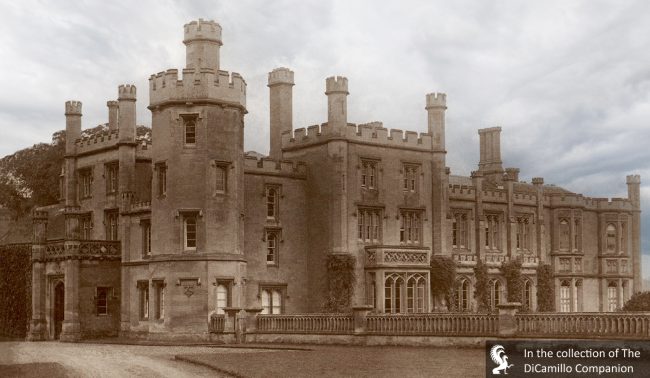
The house from a 1911 postcard
Earlier Houses: There was a Gilbertine priory founded in the 12th century by Alexander, Bishop of Lincoln, near the site of the current house. An unusual double priory (housing both men and women), the religious house was dissolved by Henry VIII in 1538 as part of the Dissolution of the Monasteries and its property granted to Edward Clinton, 1st Earl of Lincoln, the same year. Lord Lincoln sold the property soon after he acquired it; Haverholme subsequently had many owners until the core of the current house was built in the late 18th century. It’s likely that monastic buildings on the site were converted into housing after the dissolution. Legend says that Thomas Becket hid from Henry II at Haverholme in 1164, during one of his arguments with the king.
House & Family History: Denys Finch-Hatton (1887-1931), who spent part of his youth at Haverholme, is famous today because of "Out of Africa," Karen Blixen’s popular 1937 memoir. The second son of the 13th Earl of Winchilsea, Denys moved to British East Africa (today Kenya) in 1911, where he farmed and organized safaris. During World War I he became a pilot, which gave him access to unparalleled panoramic views of the African landscape. After the war his airborne observations of Africa and its wildlife convinced Denys to lobby for the first East African wildlife preserve and to ban hunting from vehicles. Part of the debauched group of British aristocrats who lived in a part of Kenya they called Happy Valley, Denys is best remembered today as the lover, and farming partner, of Baroness Karen von Blixen-Finecke. Known by her pen name of Isak Dinesen, the baroness’s account of her life in Africa was turned into the award-winning 1985 film "Out of Africa," starring Meryl Streep as the baroness and Robert Redford as Denys Finch-Hatton. On May 14, 1931, Denys was killed when his Gypsy Moth crashed soon after takeoff; prompted by his death and the financial failure of her farm, Isak Dinesen returned to live in Denmark, where she wrote the famous memoir of her time in Kenya. Denys was buried in the Ngong Hills overlooking Nairobi, where his brother erected an obelisk at his grave. For years after his death locals reported, somewhat mysteriously, that lions would come and lay on Denys’s grave for long periods of time. In 1921 Haverholme Priory was listed for sale; finding no buyers, it was mostly demolished in 1927 (a few ruined walls stand today). The house's stonework was sold to an American, who planned to rebuild it in the United States; this never occurred, and the stone was instead used to build new docks in Liverpool.
Garden & Outbuildings: In the late 19th century the 12th Earl of Winchilsea famously kept a pet lion on the grounds.
Architect: Unknown (designed by an unknown architect)
Date: 1788Architect: Henry Edward Kendall
Date: 1831
Title: Biographical Dictionary of British Architects, 1600-1840, A - HARDBACK
Author: Colvin, Howard
Year Published: 2008
Reference: pg. 611
Publisher: New Haven: Yale University Press
ISBN: 9780300125085
Book Type: Hardback
Title: No Voice From the Hall: Early Memories of a Country House Snooper
Author: Harris, John
Year Published: 1998
Publisher: London: John Murray
ISBN: 0719555671
Book Type: Hardback
House Listed: Grade II
Park Listed: Not Listed
Past Seat / Home of: SEATED AT EARLIER HOUSES: Edward Clinton, 1st Earl of Lincoln, 16th century. SEATED AT CURRENT HOUSE: Sir Samuel Gordon, 1st Bt., 1763-80; Sir Jenison William Gordon, 2nd Bt., 1780-1831. George William Finch-Hatton, 10th Earl of Winchilsea and 5th Earl of Nottingham, 1831-58; Murray; Murray Edward Gordon Finch-Hatton, 12th Earl of Winchilsea and 7th Earl of Nottingham, 1858-98; Henry Stormont Finch-Hatton, 13th Earl of Winchilsea and 8th Earl of Nottingham, 1898-1926.
Current Ownership Type: Unknown
Primary Current Ownership Use: Ruinous
House Open to Public: No
Historic Houses Member: No