

Glamis, near Forfar
Angus
Scotland
Historic County: ForfarshireCirca Date: 15th century core, incorporating earlier elements, w/17th, 18th, 19th & 20th century additions and alterations
Pronunciation: GLAHMZ
Status: Fully Extant
House Open to Public: Yes
Country House: Yes
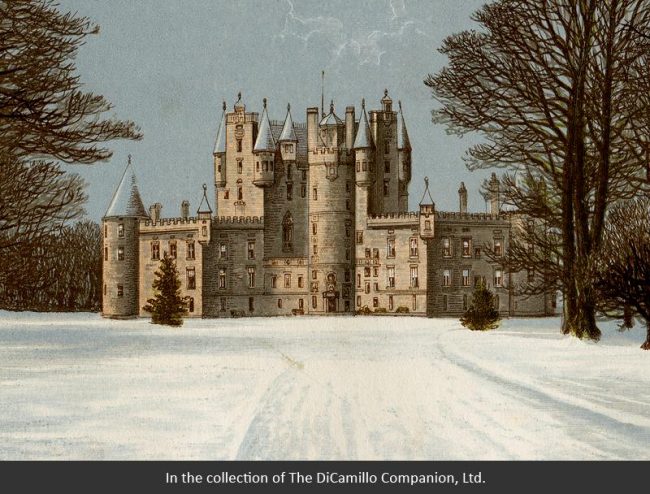
The house from "Morris's Views of Seats," circa 1875.
Earlier Houses: In 1034 King Malcolm II was mortally wounded in a battle nearby and taken to a royal hunting lodge that stood on the site of the current castle, where he died. In Shakespeare's early 17th century play "Macbeth" the title character lives at Glamis Castle, although the historical King Macbeth (died 1057) had no connection to the castle.
House & Family History: Located just 12 miles from the North Sea, Glamis is considered one of the most important castles in Scotland. In 1372 the estate was given by King Robert II to Sir John Lyon, husband of the king’s daughter. The Lyon (later Bowes-Lyon) family have been seated at Glamis ever since. Though there are earlier sections and later alterations and additions, including a major rebuild in the 15th century when the castle became a classic Scottish L-plan tower house, Glamis’s current fairy tale look was created in the 17th century during the ownership of Patrick Lyon, 3rd Earl of Strathmore. In spite of its Macbeth associations, the most famous real person to have actually lived at Glamis was Lady Elizabeth Bowes-Lyon (1900—2002), youngest child of the 14th Earl of Strathmore, who spent much of her childhood at the castle (during World War I, when Glamis was used as a military hospital, Lady Elizabeth was instrumental in organizing the rescue of the castle’s contents during a serious fire that broke out on September 16, 1916). Lady Elizabeth married Prince Albert, Duke of York (second son of King George V), at Westminster Abbey on April 26, 1923. When her husband became King George VI in 1936, she became Queen Elizabeth. She is better known as Queen Elizabeth The Queen Mother, the title she received in 1952, after the death of her husband. Glamis was also the birthplace of Lady Elizabeth’s second daughter, Princess Margaret, who was born in the castle on August 21, 1930. Glamis Castle has permeated many parts of Scottish culture. Between 1987 and 2017 an image of the castle was featured on the reverse of the Royal Bank of Scotland’s £10 notes (the engraving of Glamis was replaced by an image of otters in 2017, when polymer banknotes were introduced). In the British children’s television series "Thomas & Friends" (most famous for its Thomas the Tank Engine character) Lord Callan’s castle is based on Glamis Castle. Most Scottish castles are haunted, and Glamis is no exception. The castle’s resident ghost is the White Lady, a specter believed to be that of Janet Douglas, Lady Glamis (wife of John Lyon, 6th Lord Glamis), who was accused of witchcraft and burned at the stake in Edinburgh on July 17, 1537. But the creepy stuff doesn’t stop there! Possibly Glamis’s most scary resident was the Monster of Glamis, a supposedly horribly deformed Bowes-Lyon child who was kept locked in secret rooms in the castle all of his life. After his death the rooms where he lived were supposedly bricked over and purposely forgotten.
Collections: A large fireplace with Hercules and Samson supporting a mantle decorated with the Blakiston arms, was removed from Gibside Hall (another Bowes-Lyon house) and installed in the Billiard Room at Glamis Castle; the fireplace was just one of the fittings removed from Gibside in the 1920s and reinstalled at Glamis. The Glamis Archives, which are housed in the castle, hold a wide range of historical material on the Bowes and Lyon families, including the memoirs of famous Mary Eleanor Bowes.
Comments: The Scottish architectural historian Ian Gow called Glamis’s 19th century dining room “one of finest Scotch Baronial revival interiors.”
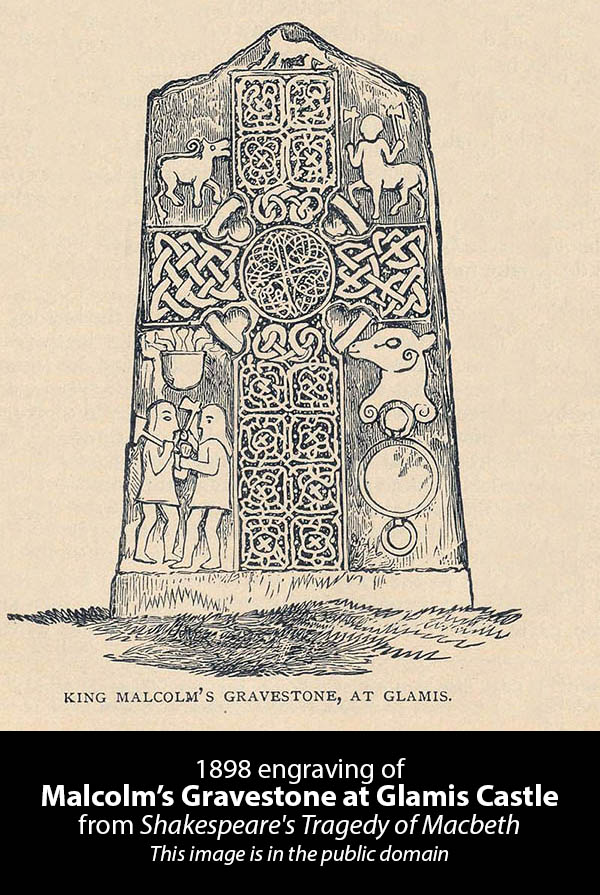
Garden & Outbuildings: On the grounds of the castle, very near the parish church of Glamis (where members of the Bowes-Lyon family have been buried for centuries), is a Pictish stone called Glamis 2. For most of its existence it was called the Glamis Manse Stone, or King Malcolm’s Gravestone, which refers to the belief that it marks the burial spot of Malcolm II, king of Scotland, who died in 1034. Malcolm was the grandfather of King Duncan I (died 1040), who was, at least in the famous play, killed by Macbeth (in reality, he was killed in battle by Macbeth’s troops). In an interesting twist of history, the gravestone is older than the man whom it memorializes, probably because the grave marker was the reuse of an existing Bronze Age standing stone. The estate, which today spans more than 14,000 acres, produces several cash crops, including beef and lumber, and also features gardens and woodlands, including an arboretum with trees from all over the world.
Chapel & Church: There is a small chapel located within the castle.
John Bernard (J.B.) Burke, published under the title of A Visitation of the Seats and Arms of the Noblemen and Gentlemen of Great Britain and Ireland, among other titles: 2.S. Vol. II, p. 24, 1855
John Preston (J.P.) Neale, published under the title of Views of the Seats of Noblemen and Gentlemen in England, Wales, Scotland, and Ireland, among other titles: Vol. VI, 1823. Scotland, 1830.
Country Life: II, 293, 1897. XX, 234, 1906. XXXVI, 196 plan, 1914. LIII, 114, 1923. CI, 860, 910 plan, 1947.
House Listed: Category A
Park Listed: Listed as a Garden & Designed Landscape
Current Seat / Home of: Simon Patrick Bowes-Lyon, 19th and 6th Earl of Strathmore and Kinghorne; Lyon family here since the 14th century.
Past Seat / Home of: SEATED AT EARLIER HOUSE: Sir John Lyon, 14th century. SEATED AT CURRENT HOUSE: Patrick Lyon, 1st Lord Glamis, until 1459; Alexander Lyon, 2nd Lord Glamis, 1459-86; John Lyon, 3rd Lord Glamis, 1486-97; John Lyon, 4th Lord Glamis, 1497-1500; George Lyon, 5th Lord Glamis, 1500-05; John Lyon, 6th Lord Glamis, 1505-28; John Lyon, 7th Lord Glamis, 1528-58; John Lyon, 8th Lord Glamis, 1558-78; Patrick Lyon, 9th Lord Glamis and 1st Earl of Kinghorne, 1578-1615; John Lyon, 2nd Earl of Kinghorne, 1615-46; Patrick Lyon, 3rd Earl of Strathmore and Kinghorne (earldom's name changed to Strathmore and Kinghorne), 1646-95; John Lyon, 4th Earl of Strathmore and Kinghorne, 1695-1712; John Lyon, 5th Earl of Strathmore and Kinghorne, 1712-15; Charles Lyon, 6th Earl of Strathmore and Kinghorne, 1715-28; James Lyon, 7th Earl of Strathmore and Kinghorne, 1728-35; Thomas Lyon, 8th Earl of Strathmore and Kinghorne, 1735-53; John Bowes, 9th Earl of Strathmore and Kinghorne, 1753-76; John Bowes, 10th Earl of Strathmore and Kinghorne, 1776-1820; Thomas Lyon-Bowes, 11th Earl of Strathmore and Kinghorne, 1820-46; Thomas Lyon-Bowes, 12th Earl of Strathmore and Kinghorne, 1846-65; Claude Bowes-Lyon, 13th Earl of Strathmore and Kinghorne, 1865-1904; Claude George Bowes-Lyon, 14th and 1st Earl of Strathmore and Kinghorne (in 1937 the 14th Earl was given a new United Kingdom title of 1st Earl of Strathmore and Kinghorne [the earlier Earldom of Strathmore and Kinghorne was a Scottish title] in recognition of his daughter being crowned queen consort in 1937), 1904-44; Patrick Bowes-Lyon, 15th and 2nd Earl of Strathmore and Kinghorne, 1944-49; Timothy Bowes-Lyon, 16th and 3rd Earl of Strathmore and Kinghorne, 1949-72; Fergus Michael Claude Bowes-Lyon, 17th and 4th Earl of Strathmore and Kinghorne, 1972-87; Michael Fergus Bowes-Lyon, 18th and 5th Earl of Strathmore and Kinghorne, 1987-2017.
Current Ownership Type: Individual / Family Trust
Primary Current Ownership Use: Private Home
House Open to Public: Yes
Phone: 01307-840-393
Fax: 01307-840-733
Email: [email protected]
Website: https://www.glamis-castle.co.uk/
Awards: 2003 International Ambassador Award for achievement in attracting international visitors to the area.
Historic Houses Member: Yes