

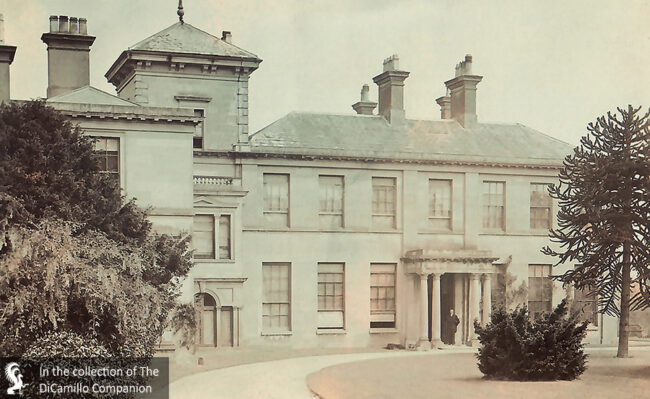
The house from a 1912 postcard
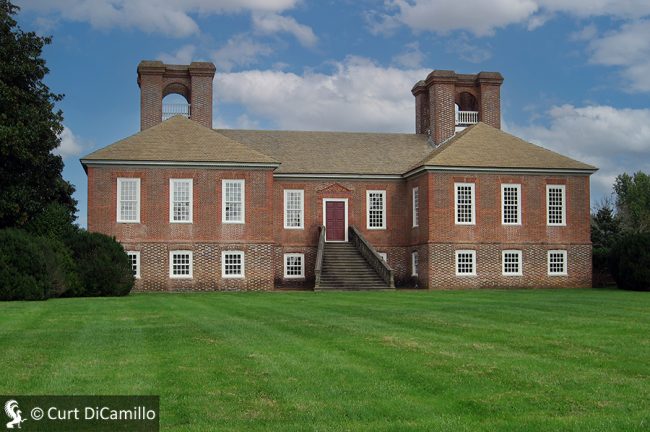
Stratford Hall, Virginia.
Earlier Houses: Beginning in the 14th century, the Lee family, originally named de la Lee and probably of Norman origin, were seated at an earlier house on the site. By the 17th century the Lees owned a sizeable piece of Shropshire (approximately 5,000 acres in the parish of Alveley).
Built / Designed For: Harry Lancelot Lee
House & Family History: Standing over 500 feet above seal level, Coton Hall is somber, gray ashlar classical style house with a slate roof that was built circa 1800-02 for Harry Lancelot Lee. At his death in 1821 Coton Hall was sold and passed out of Lee family ownership. One of the house’s most prominent features is the Italianate turret, which was added as part of the Victorian wing that was built in the 1860s. Coton is particularly notable today as the ancestral home of the Lee family, who were wealthy merchants, politicians, and landowners in Virginia. Richard Lee I, who immigrated to Virginia from Shropshire in 1639, founded the American Lee dynasty and became one of the largest landowners in 17th century Virginia. In the early 18th century his grandson, Colonel Thomas Lee, built Stratford Hall on the Potomac River in Westmoreland County, Virginia (see "Images" section). Considered one of the most important historic houses in America, Stratford Hall was where Col. Lee's sons, Richard Henry Lee and Francis Lightfoot Lee, the only brothers to sign the Declaration of Independence, were born. It was Francis Lightfoot's son, Light Horse Harry Lee (Henry Lee III), a famous soldier of the American War of Independence, who was the father of General Robert E. Lee, the commander of the Confederate States Army during the American Civil War. The Thompson family, who owned Coton Hall in the 20th century, sold it in 1985. In 2003 the house, together with 6.5 acres, went on the market with a guide price of £1.25 million; in 2018 Coton sold for £1.625 million. One of the house’s most prominent features is the Italianate turret, which was added as part of the Victorian wing that was built in the 1860s.
Chapel & Church: The grounds contain the ruins of a chapel that locals believe dates from the 13th century (with later alterations). The architectural historian Marcus Binney disputes this claim: “Local historians have claimed that this is the chapel of ancient Saxon kings, but it is a simple Palladian box with a pretty Strawberry Hill Gothic window in the east end. It is attributed to Shrewsbury architect Thomas Farnolls Pritchard.” In 1878 the chapel roof collapsed, and all the Lee monuments were moved to Alveley church.
Architect: Thomas Farnolls Pritchard
Date: Circa 1765
Title: Disintegration of a Heritage: Country Houses and their Collections, 1979-1992, The
Author: Sayer, Michael
Year Published: 1993
Publisher: Norfolk: Michael Russell (Publishing)
ISBN: 0859551970
Book Type: Hardback
House Listed: Grade II
Park Listed: Not Listed
Past Seat / Home of: SEATED AT EARLIER HOUSE: Lee family, originally named de la Lee, 14th century to 18th century. SEATED AT CURRENT HOUSE: Harry Lancelot Lee, 1800-21; Lee family here from the 14th century until 1821. Edward Lloyd Gatacre, until 1851. The Rev. Edward Ward Wakeman, 1851-55; Offley Francis Drake Wakeman, 1855-65; Edward Maltby Wakeman, 1865-1926; Capt. Hugh Davenport Wakeman-Coleville, 1930s. Howard Thompson, 1940s.
Current Ownership Type: Individual / Family Trust
Primary Current Ownership Use: Private Home
House Open to Public: No
Historic Houses Member: No